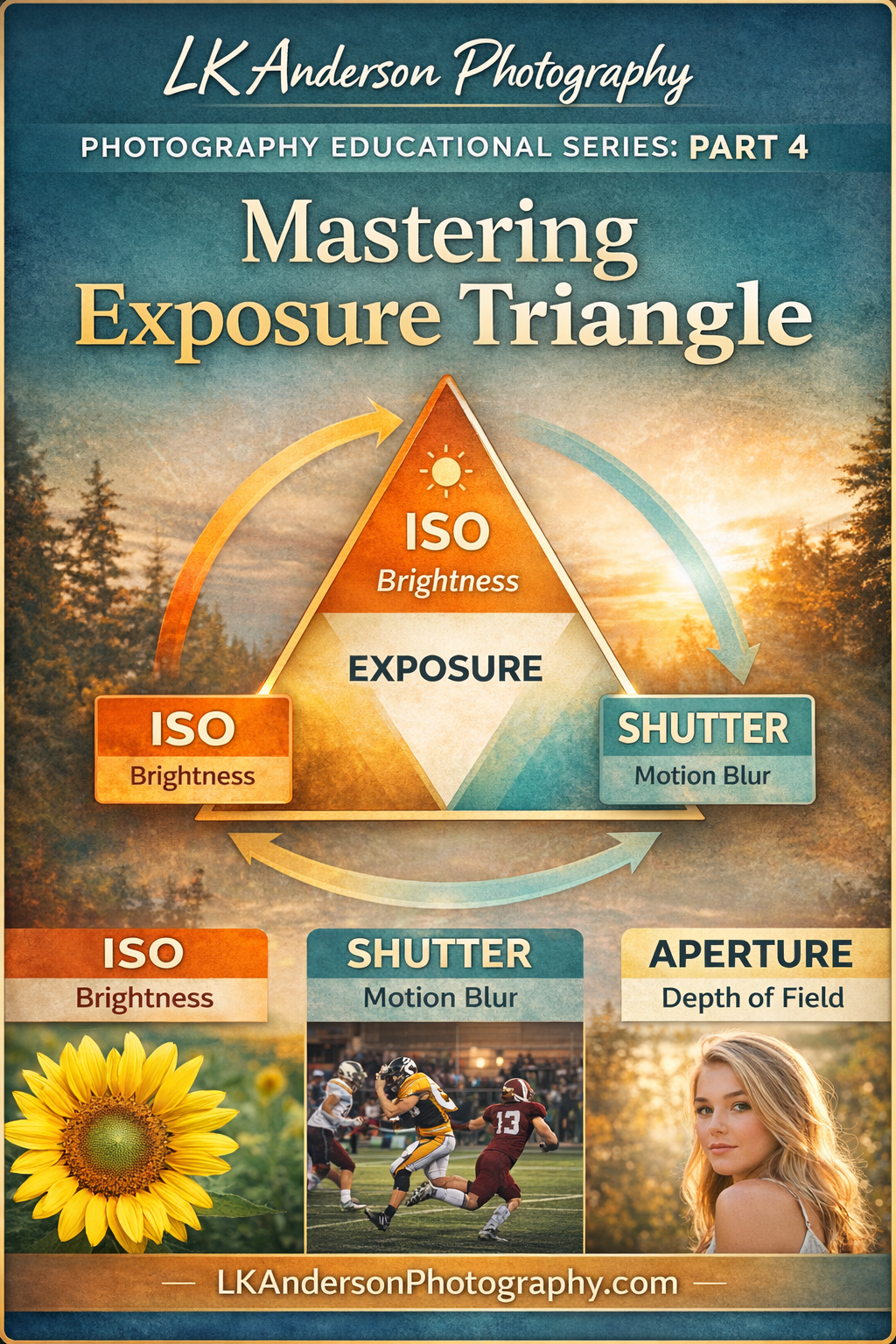
Tying It All Together: ISO, Shutter Speed & Aperture
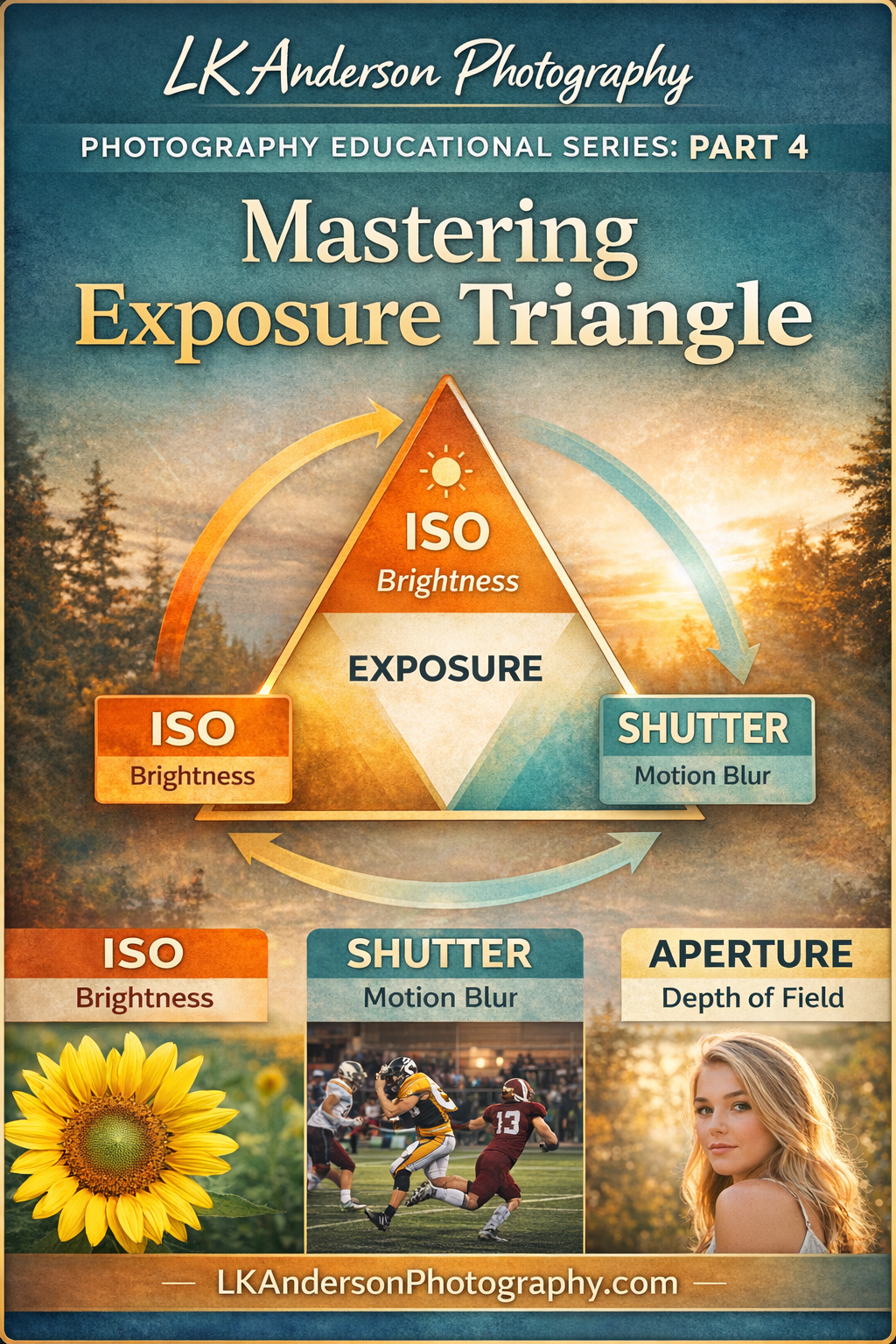
If you’ve been following along in this Photography Educational Series, you’ve already met the Exposure Triangle: ISO, Shutter Speed, and Aperture. In Parts 1–3, we broke each one down individually. Now it’s time to bring them together and understand how they work as a team.
Think of this as the moment when photography starts to click.
The Exposure Triangle (Quick Recap)
Every properly exposed photo depends on balancing three settings:
- Aperture – how much light enters the lens and how blurry the background is
- Shutter Speed – how long light hits the sensor and how motion is frozen or blurred
- ISO – how sensitive the camera sensor is to light
Change one, and the others must usually adjust to compensate.
How They Work Together (Real-World Explanation)
Imagine your camera like a window:
- Aperture is how wide the window opens
- Shutter Speed is how long the window stays open
- ISO is how sensitive your eyes are to the light coming in
To get the perfect exposure, all three must be in balance.
Example 1: Bright Outdoor Portrait
You’re photographing a senior outside in full daylight.
- Aperture: f/2.8 (beautiful background blur)
- Shutter Speed: 1/2000 (very fast to control the light)
- ISO: 100 (lowest noise, best quality)
Because there’s plenty of light, ISO stays low and shutter speed speeds up to prevent overexposure.
Example 2: Indoor Gym or School Photoshoot
Now you’re inside a gym or school hallway with less light.
- Aperture: f/2.8 – f/3.5 (let in as much light as possible)
- Shutter Speed: 1/250 – 1/400 (fast enough to freeze motion)
- ISO: 800 – 1600 (boost light sensitivity)
Here, ISO increases because shutter speed can’t slow down too much without causing blur.
Example 3: Sports Action Shot
Fast-moving athletes require a different balance.
- Aperture: f/2.8 – f/4
- Shutter Speed: 1/1000 or faster
- ISO: Adjusted as needed (often 1600+ indoors)
In sports photography, shutter speed is the priority, and ISO flexes to make it work.
One Change Affects Everything
Here’s the key takeaway:
- Open your aperture → you may need a faster shutter or lower ISO
- Increase shutter speed → you may need a wider aperture or higher ISO
- Raise ISO → you can use a faster shutter or smaller aperture
Photography is a constant balancing act.
Which Setting Should You Control First?
A helpful rule of thumb:
- Portraits: Start with Aperture
- Sports / Action: Start with Shutter Speed
- Low Light: Start with ISO, then fine-tune the rest
Let your subject decide which setting matters most.
Why This Matters
Understanding how ISO, shutter speed, and aperture work together gives you:
- Creative control over your images
- Consistent exposure in changing light
- Confidence shooting in manual mode
This is the difference between taking pictures and creating images.
Final Thoughts
Mastering the Exposure Triangle doesn’t happen overnight — and that’s okay. With practice, adjusting these three settings will become second nature.
In the next part of this series, we’ll start focusing on using light creatively, not just correctly.
Stay tuned for Part 5 of the Photography Educational Series 📸
Written by LK Anderson Photography – serving Southeast Texas